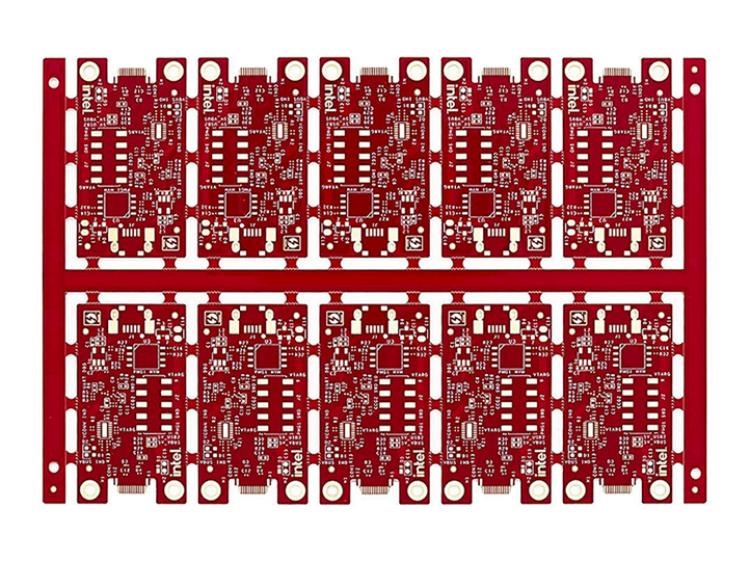


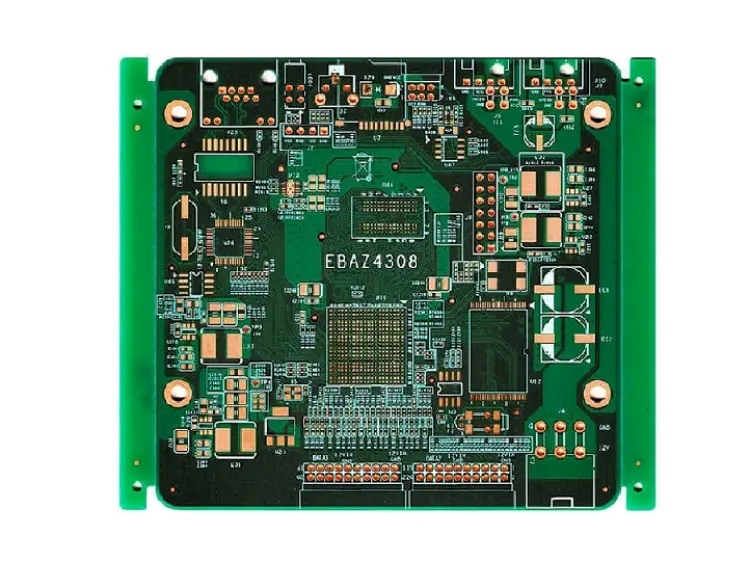
Power electronic devices often operate under demanding thermal and electrical conditions. Their circuit boards must withstand repeated heating during assembly while maintaining reliable mechanical and electrical properties. A FR4 circuit board for power electronics therefore needs suitable thermal performance, especially when manufacturers use lead-free soldering processes. Selecting a high glass transition temperature (Tg) material helps reduce the risk of excessive substrate softening and dimensional changes during high-temperature assembly.
The glass transition temperature describes the point at which the resin system changes from a rigid glassy state to a softer condition. Standard FR4 materials may not provide sufficient thermal margins for every demanding application. In contrast, high Tg FR4 grades, such as those with Tg values between 170°C and 180°C, offer improved resistance to thermal stress. Consequently, they are suitable for multilayer designs that must maintain structural stability throughout lead-free reflow.
How Lead-Free Reflow Affects FR4 Material Performance
Lead-free soldering typically requires higher processing temperatures than traditional lead-based soldering. During reflow, the PCB experiences rapid heating, a peak temperature, and subsequent cooling. These temperature changes place stress on the resin system, copper layers, plated through-holes, and interfaces between different materials. If the substrate cannot tolerate the thermal profile, it may experience warpage, delamination, or other reliability problems.
A high Tg material provides a larger thermal performance margin during assembly. However, Tg alone does not determine the complete thermal reliability of a PCB. Manufacturers should also consider the material’s decomposition temperature, coefficient of thermal expansion (CTE), moisture absorption, and thermal cycling performance. In addition, a properly controlled reflow profile helps prevent unnecessary thermal exposure.
Key Factors for Maintaining High Tg Stability
Choosing suitable materials is the first step toward reliable production. A FR4 circuit board for power electronics should match the thermal requirements of its components, layer structure, and assembly process. For example, multilayer boards with dense copper distribution may experience different thermal behavior from simpler designs. Therefore, engineers should evaluate the complete stack-up rather than selecting materials based only on nominal Tg values.
Several factors contribute to stable performance during lead-free reflow:
- High Tg resin selection: Choose FR4 materials with Tg values suitable for the intended assembly temperature.
- Controlled CTE: Evaluate expansion behavior, particularly in the Z-axis, to reduce stress on plated through-holes.
- Moisture management: Use appropriate storage and baking procedures when required to reduce moisture-related defects.
- Balanced copper distribution: Maintain a suitable layer design to help minimize thermal warpage.
- Optimized reflow profiles: Control preheating, soak time, peak temperature, and cooling rate according to material and solder paste requirements.
These measures work together to improve manufacturing consistency. Furthermore, early communication between PCB designers, fabricators, and assembly teams can help identify thermal risks before mass production.
Technical Specifications for High Tg FR4 PCB Manufacturing
Different power electronics applications require different board thicknesses, layer counts, and dimensional tolerances. FR4 printed circuit boards can support a wide range of designs, from compact control boards to complex multilayer structures. The following specifications illustrate the available manufacturing options.
| Technical Parameter | Available Specification | Design Consideration |
|---|---|---|
| Board thickness | 0.2–6.0 mm | Supports different mechanical and installation requirements |
| Layer count | Up to 32 layers | Accommodates complex circuit routing |
| Panel size | Up to 1200 × 600 mm | Supports different production layouts |
| Dimensional tolerance | ±0.05 mm | Helps maintain manufacturing consistency |
| High Tg material | 170–180°C | Improves thermal stability during assembly |
| Controlled impedance | ±10% | Supports signal integrity requirements |
| Peel strength | Above 1.0 N/mm | Supports copper-to-substrate bonding reliability |
| Flammability rating | UL94 V-0 | Provides a defined flammability classification |
These capabilities allow manufacturers to support different industrial power supply PCBs and other demanding electronic assemblies. Nevertheless, final specifications should be confirmed according to the selected laminate, board structure, and application requirements.
Advanced Manufacturing Processes That Support PCB Reliability
Material selection must be supported by precise manufacturing processes. During multilayer PCB manufacturing, each production stage can influence dimensional accuracy, copper adhesion, and electrical performance. Baiyoudi uses advanced manufacturing capabilities to support complex PCB designs and tighter process control. Laser direct imaging supports fine pattern formation, with line and space resolution down to 25 μm. Meanwhile, plasma desmear prepares hole walls for reliable metallization by removing resin residue after drilling. Automated optical inspection can detect defects down to 10 μm, helping identify potential pattern issues before boards move to later production stages.
Impedance control is another important consideration for power electronics designs that include sensitive signal paths. TDR methodology verifies impedance characteristics against the specified requirements. In addition, controlled dielectric thickness and consistent layer alignment help maintain electrical performance. Together, these processes support repeatable production quality across different PCB configurations.

How to Evaluate PCB Quality Before Assembly
A reliable FR4 circuit board for power electronics requires more than a high Tg specification. Buyers should review material documentation, dimensional inspection results, electrical test reports, and manufacturing process controls. They should also confirm whether the selected laminate is compatible with the intended lead-free reflow profile. This evaluation helps reduce the risk of assembly defects and unexpected performance changes.
Several quality checks deserve attention before production approval:
- Material verification: Confirm the laminate grade and Tg documentation.
- Dimensional inspection: Check board thickness, panel dimensions, and tolerance compliance.
- Visual inspection: Review copper patterns, solder mask coverage, and surface defects.
- Electrical testing: Verify continuity, insulation resistance, and specified impedance where applicable.
- Thermal evaluation: Assess the board under representative assembly conditions when required.
For high-reliability applications, engineers should also consider thermal cycling and other qualification tests based on the product’s operating environment.
Choosing the Right FR4 PCB Manufacturing Partner
Selecting a capable high-frequency PCB supplier or general PCB manufacturing partner requires evaluating more than production capacity. Buyers should consider material availability, multilayer processing experience, inspection equipment, and the ability to meet specific electrical and mechanical requirements. For power electronics, clear communication about laminate selection and assembly conditions is particularly important.
Baiyoudi supports FR4 PCB projects with high Tg material options, multilayer manufacturing capabilities, controlled impedance processes, and advanced inspection technologies. By aligning material selection with board design and lead-free assembly requirements, manufacturers can improve production consistency and reduce avoidable thermal reliability risks. Ultimately, high Tg stability depends on the combined performance of materials, PCB design, manufacturing processes, and reflow control. A well-engineered FR4 solution can help power electronic assemblies maintain structural integrity and reliable electrical performance throughout production and service.