


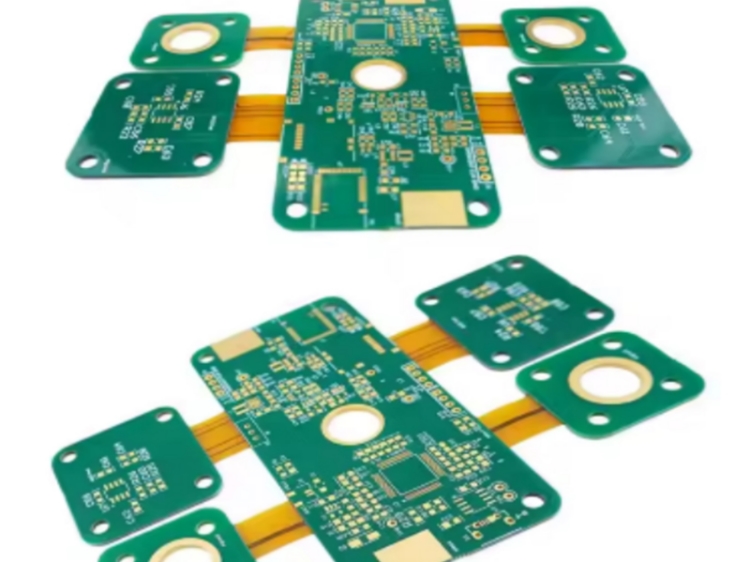
In advanced PCB manufacturing, lamination quality directly determines long-term reliability and mechanical stability. When engineers fail to control key parameters, defects appear during production or later field operation. In particular, the rigid flex lamination process plays a key role because it bonds rigid layers with flexible substrates under heat and pressure. Therefore, even small deviations in temperature, pressure, or material alignment create serious performance issues. Baiyoudi, with 13 years of rigid-flex manufacturing experience, continuously improves process control to reduce these risks and deliver high-reliability PCB assembly solutions.
Delamination and Layer Separation Failures
First of all, delamination ranks as one of the most common defects in unstable lamination conditions. When heat distribution or pressure control becomes inconsistent, the bonding interface between rigid and flexible layers loses strength. As a result, layers separate during thermal cycling or dynamic bending stress. Moreover, high-layer-count boards increase internal stress, which makes the structure more vulnerable. The rigid flex lamination process must maintain stable adhesion energy to prevent micro-void formation and ensure long-term structural integrity.
Warpage and Dimensional Instability
In addition, warpage occurs when engineers fail to balance pressure or control cooling rates properly. Uneven thermal expansion between different materials causes PCB deformation after lamination. Consequently, assembly accuracy drops and SMT processes lose stability. Furthermore, Baiyoudi uses advanced DFM tools such as bending radius calculation and stress simulation to optimize design before production. Through these methods, engineers maintain stable geometry even under complex environmental conditions and mechanical loads.
Crack Formation in Transition Zones
Moreover, cracks often develop in rigid-to-flex transition areas when engineers do not properly manage stress concentration. These defects become especially critical in dynamic bending applications. Baiyoudi validates designs through over 200,000 bending cycles under IPC-6013D Class 3 standards. However, when engineers execute the rigid-flex lamination process poorly, micro-cracks expand under repeated stress and eventually cause electrical failure or structural breakdown.
Adhesive Flow and Resin Imbalance Issues
Furthermore, improper temperature control increases adhesive flow during lamination. Excess resin spreads unevenly, creating thickness variation across layers. As a result, impedance stability decreases in high-speed circuit designs. In addition, resin imbalance weakens certain structural zones and reduces long-term durability. Therefore, engineers must carefully control heating curves, pressure stages, and dwell time to ensure stable material behavior.
Misalignment and Registration Errors
In many cases, engineers observe layer misalignment when stacking accuracy decreases before lamination. Even slight positional shifts affect circuit continuity and reduce yield rates. Consequently, manufacturers implement precise alignment systems and strict pre-lamination inspection routines. Baiyoudi applies a 38-point inspection checklist and high-precision tooling to minimize alignment risks in complex rigid-flex structures.
Electrical Reliability Degradation
In addition, poor lamination control affects Z-axis stability and increases electrical resistance over time. Under harsh environmental conditions such as HAST testing (130°C/85%RH), poorly processed boards fail earlier than expected. Therefore, engineers must strictly control every stage of the rigid flex lamination process to ensure stable conductivity and long-term electrical reliability.
Conclusion: Process Control Determines Final Performance
In conclusion, most rigid-flex PCB defects originate from unstable lamination conditions, including delamination, warpage, cracking, and misalignment. However, advanced engineering systems significantly reduce these risks when engineers apply them correctly. Baiyoudi integrates DFM optimization tools, rapid prototyping systems, and certified standards such as ISO 13485 and IATF16949 to maintain consistent production quality. As a result, high-reliability rigid-flex PCB solutions achieve stable performance even in demanding industrial and electronic applications.